
What is the origin of the Universal Laws? In science and, in particular, physics Isaac Newton was the first to use the term Universal Laws. These are the natural inescapable laws of the Universe. They have been expanded upon since by scientists like Albert Einstein, who discovered the Law of Relativity.
In Egyptian Greek philosophy, Hermes Trismegistus explains the foundational laws of our reality in his seven hermetic principles. Ho’oponopono was a practice in ancient Hawaii, which now includes a recognition of various Universal Laws and their application in everyday life. Qabalah contains 10 Universal Laws. Hinduism contains 12 Laws of Karma.
So basically, the 12 Universal Laws are pulled together from a variety of both scientific and spiritual sources and are widely accepted today. The way you apply them is an individual choice. For instance, understanding Law of Divine Oneness often depends on your beliefs and differs between spiritual paths and religions around the world. Applying or understanding these laws helps you become a better person, which is both beneficial to you and those you have relations or dealings with.
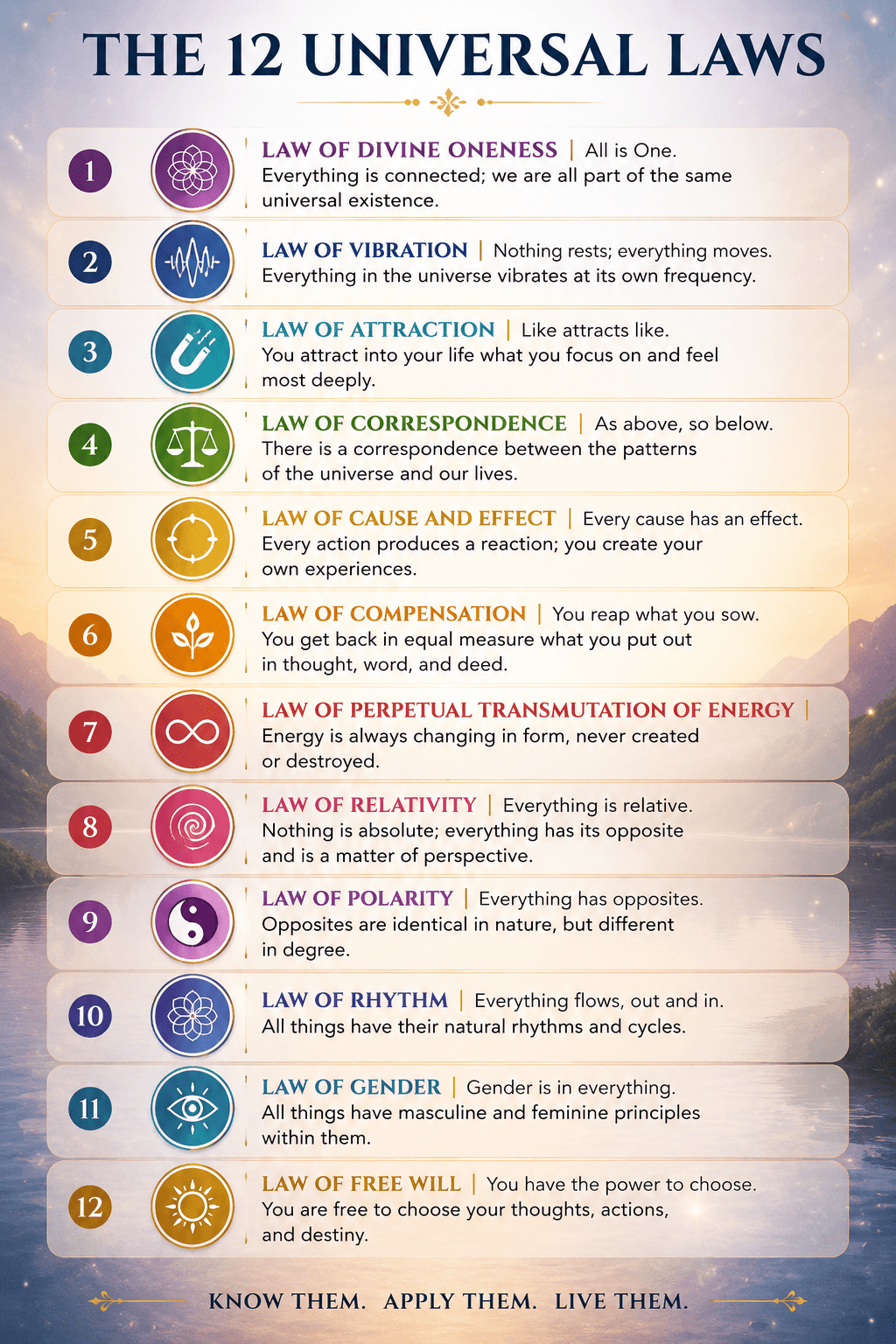
The 12 Universal Laws
1. Law of Divine Oneness
All is One.
Everything is connected; we are all part of the same universal existence.
2. Law of Vibration
Nothing rests; everything moves.
Everything in the universe vibrates at its own frequency.
3. Law of Attraction
Like attracts like.
You attract into your life what you focus on and feel most deeply.
4. Law of Correspondence
As above, so below.
There is a correspondence between the patterns of the universe and our lives.
5. Law of Cause and Effect
Every cause has an effect.
Every action produces a reaction; you create your own experiences.
6. Law of Compensation
You reap what you sow.
You get back in equal measure what you put out in thought, word, and deed.
7. Law of Perpetual Transmutation of Energy
Energy is always changing in form, never created or destroyed.
8. Law of Relativity
Everything is relative.
Nothing is absolute; everything has its opposite and is a matter of perspective.
9. Law of Polarity
Everything has opposites.
Opposites are identical in nature, but different in degree.
10. Law of Rhythm
Everything flows, out and in.
All things have their natural rhythms and cycles.
11. Law of Gender
Gender is in everything.
All things have masculine and feminine principles within them.
12. Law of Free Will
You have the power to choose.
You are free to choose your thoughts, actions, and destiny.
Know Them. Apply Them. Live Them.
 Paths of Enlightenment
Leave a comment