
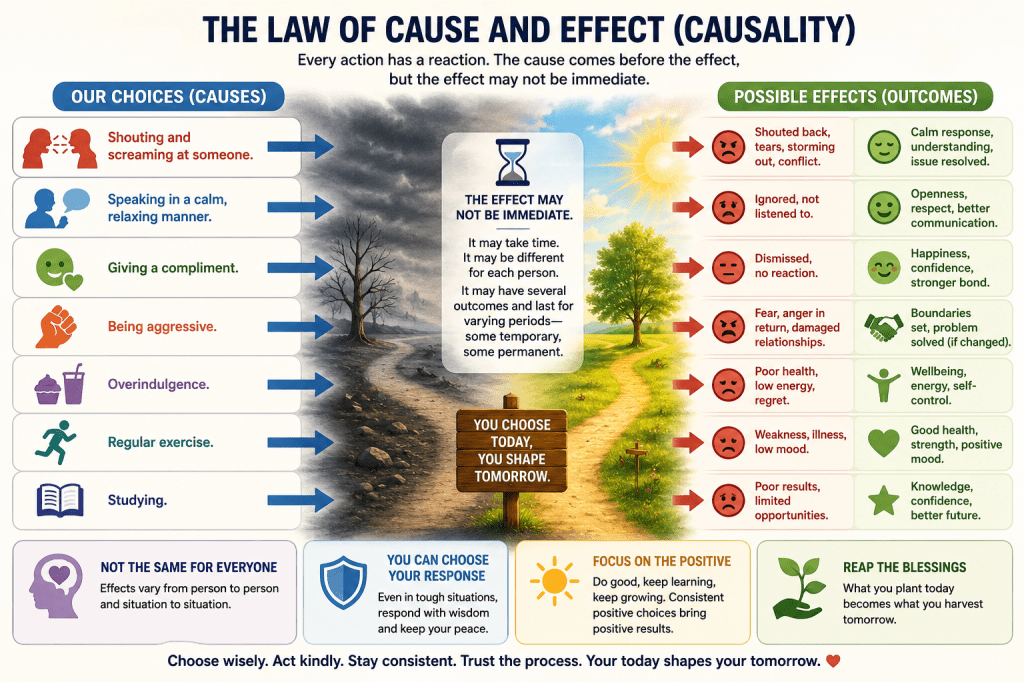

In modern physics, the notion of causality is clarified as “the cause must precede the effect”. And depending on the cause, the effect might not happen straight away.
Cause and effect is where one event, process, state, or object (a cause) contributes to the production of another event, process, state, or object (an effect).
An example could be cleaning your teeth. If you don’t clean your teeth regularly (cause) you may not see an immediate effect, but after a while, you may experience tooth decay or gum disease (effect). On the other hand, if you do clean your teeth every day (cause), you are likely to have healthy gums and teeth (effect).
But let’s take it to a level of improving your own life. I won’t tell you the effect, but see if you can work out for yourself what the effect will be from the causes below: –
- Shouting and screaming at someone.
- Speaking in a calm, relaxing manner.
- Giving a compliment.
- Being aggressive.
- Overindulgence.
- Regular exercise.
- Studying.
Effects are not the same with everyone. For instance, as in example 1 (above), the effect could be several things depending on the invidual. Possible outcomes are shouting back, being reduced to tears, and storming out. A more positive effect would be the recipient reacting in a calm way and finding out why we are so angry.
So, although every action has a reaction, it may not be immediate and could have several outcomes. Sometimes, we need to think of how we personally react to things to get a full perspective. Some situations need confronting, but sometimes it might be better to just walk away.
Effects also last for different periods depending on the cause. Some can be permanent. Some causes and effect we have absolutely no control of. But we can control how we cope with them.
But don’t see it as a negative thing. Even if something has a negative reaction, we can still react in a positive way, thus reducing the outcome. However, if we keep doing positive things in our lives, we will reap the blessings.

 Paths of Enlightenment
Leave a comment