

Throughout history, wolves and sheep have been used as powerful symbols. Sheep often represent innocence, obedience, and dependence, while wolves are portrayed as dangerous predators, cunning deceivers, or enemies to be feared. This imagery is particularly common in the Bible, where “wolves in sheep’s clothing” warn against false teachers and “the wolf” symbolizes those who prey upon the vulnerable.
Yet nature paints a more nuanced picture than symbolism alone. Looking beyond metaphor, wolves and sheep offer two very different ways of living, each with strengths and weaknesses. Spiritually, they also raise important questions about leadership, freedom, responsibility, and the search for truth.
The Reality of Wolves
The wolf has long suffered from an undeserved reputation. Folklore, fairy tales, and religious imagery often cast it as a villain, but modern studies of wolves reveal a remarkably social, intelligent, and cooperative animal.
A wolf pack is not a ruthless dictatorship. Rather, it is a close-knit family. Parents raise their young together, older siblings help care for pups, and every member contributes according to its abilities. Wolves communicate constantly through body language, vocalisations, scent, and touch. Cooperation is essential to their survival.
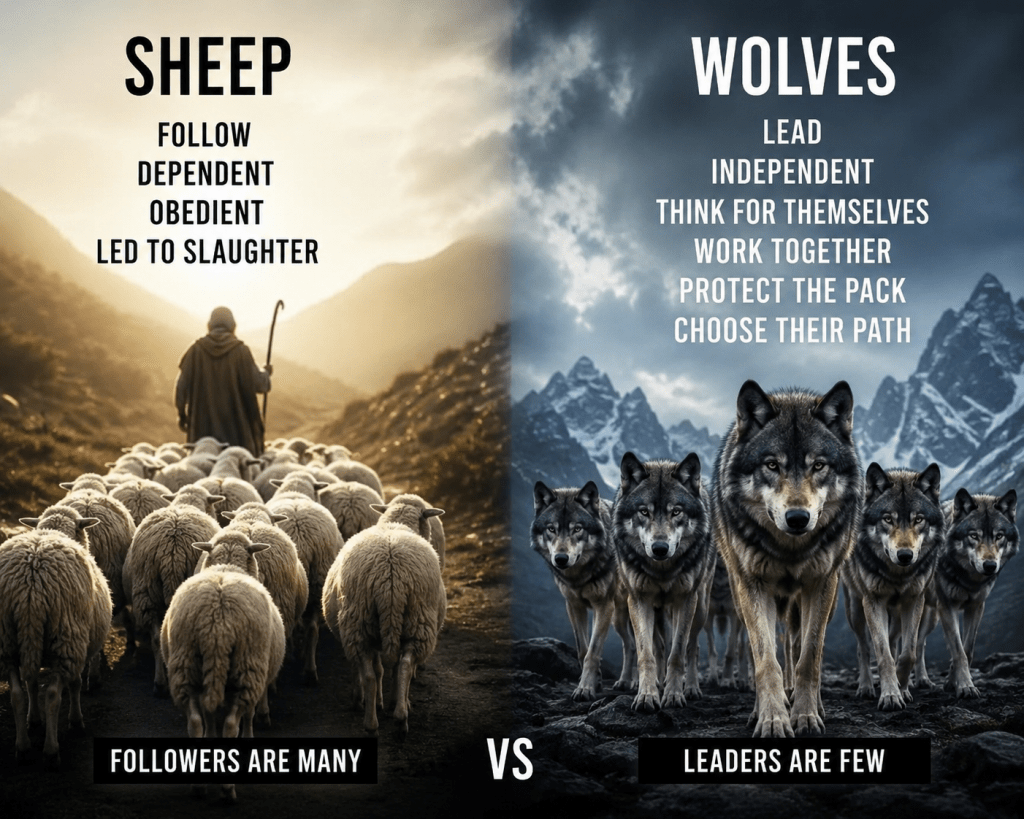
Although they work together, wolves are not mindless followers. Every wolf has its own personality. Some are bold, others cautious; some naturally lead, while others excel in supporting roles. Leadership is often earned through experience rather than domination.
Spiritually, the wolf represents balance between individuality and community. It teaches that strength comes not from blind obedience but from freely choosing to work together for the good of the whole.
The Nature of Sheep
Sheep possess admirable qualities too. They are gentle, peaceful, and highly social animals. Their instinct is to remain together, finding safety in the flock.
However, sheep are also dependent. Left entirely alone they become vulnerable and often require guidance from a shepherd to find food, water, and protection. Their instinct is generally to follow the group, sometimes without questioning where it is going.
This dependence has made sheep a powerful religious symbol of believers following God, with Christ described as the Good Shepherd.
Yet the same symbolism also raises an uncomfortable truth. Sheep may faithfully follow their shepherd—but they can also be led wherever the shepherd chooses, even to slaughter. Their greatest strength—trust—can become their greatest weakness if placed in the wrong leader.
Wolves and Sheep Compared
The contrast between wolves and sheep is often exaggerated.
- Both are social creatures.
- Both care deeply for their families.
- Both survive through cooperation.
- Both rely upon their communities.
The difference lies largely in how they cooperate.
- Sheep follow because safety lies in conformity.
- Wolves cooperate because each member actively contributes while retaining its own role and awareness.
One model emphasises dependence; the other encourages participation.
A Spiritual Perspective
Many spiritual traditions encourage people to awaken their own inner wisdom rather than simply accept what they are told. Growth often begins by asking questions, examining beliefs, and taking responsibility for one’s own path.
In this sense, the wolf becomes a symbol of discernment and personal responsibility.
Being “wolf-like” does not mean becoming selfish or predatory. Instead, it can mean:
- Thinking independently.
- Protecting your community.
- Leading through example rather than control.
- Working together without surrendering your individuality.
- Remaining loyal while retaining the freedom to question.
This contrasts with a purely “sheep-like” spirituality, where unquestioning obedience may discourage personal growth and discernment.
Rethinking the Biblical Image
The Bible’s warnings about wolves were intended as moral metaphors rather than zoological descriptions. They caution against people who exploit others for personal gain. Those teachings remain valuable in that context.
However, they should not be mistaken for a judgement on wolves themselves.
Ironically, many of the qualities admired in spiritual communities—loyalty, sacrifice, protection of family, cooperation, courage, and mutual care—are precisely the qualities displayed by healthy wolf packs.
Perhaps the deeper lesson is not to become either wolf or sheep, but to recognise when symbolism no longer reflects reality.
Walking Your Own Path
The spiritual journey is ultimately about balance.
Like sheep, we benefit from companionship, compassion, and belonging.
Like wolves, we flourish when we think for ourselves, accept responsibility, and contribute our unique gifts to the community.
True wisdom is not blind obedience, nor isolated independence. It is learning to walk beside others without surrendering your own conscience.
Perhaps the greatest spiritual lesson of the wolf is this:
“Walk with the pack, but never lose your own path.”
 Paths of Enlightenment
Leave a comment